

Threat hunting is an important component of security operations center services that should be implemented as soon as possible. Threat hunting is the skill of detecting unknowns in the environment, extending beyond typical detection systems like SIEM, EDR, and others. Hunting can be done in a variety of ways, and your team can choose the one that best suits your needs.
The Pyramid of Pain by David Bianco demonstrates how threat hunting should be carried out to guarantee that threat actors are noticed, identified, and isolated before they impact the environment.
Is used to demonstrate the relationship between the types of indicators available to detect a threat actor’s activities and the difficulty it will be for the threat actor to change those indicators.
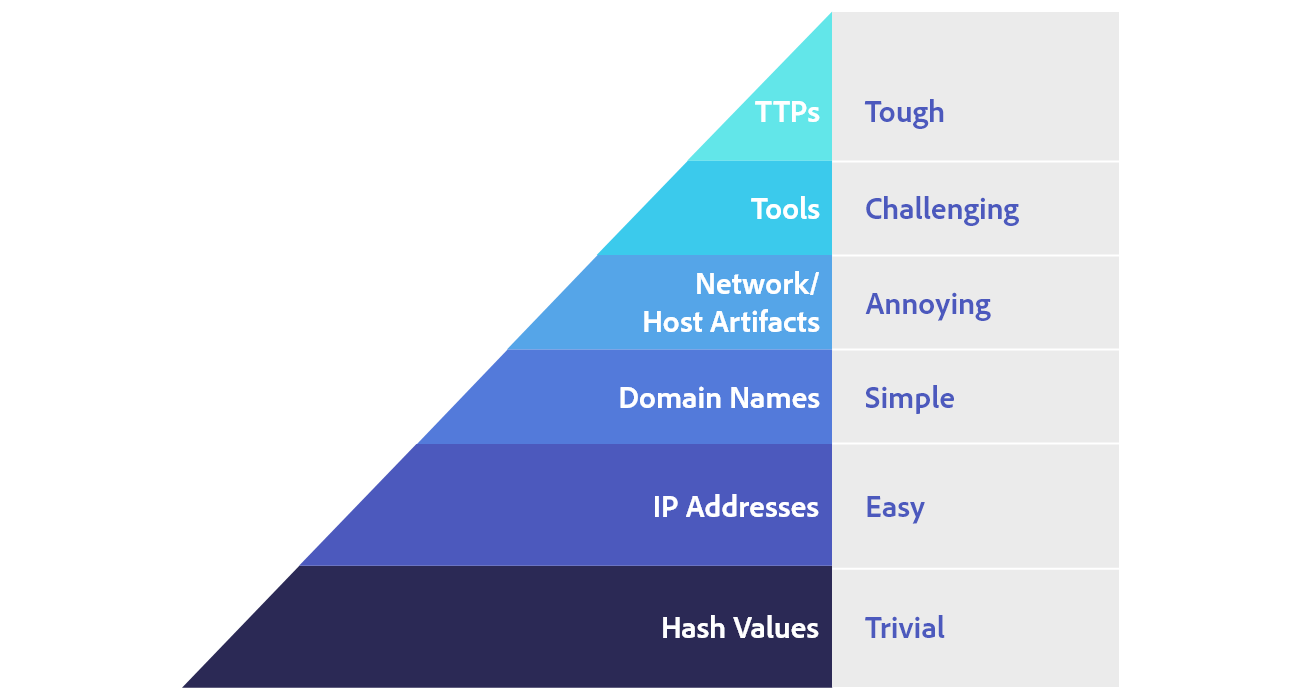
The environment’s fecundity is crucial to a successful search. SIEM and EDR tools are commonly used by hunters as the foundation for their hunts. They can also use other tools to conduct network-based hunts, such as packer analyzers.
SIEM and EDR technologies, on the other hand, demand that all of your environment’s “crown jewels” be interconnected. This ensures the use of an indicator of attack (IoA) and an indicator of compromise (IoC) in the hunt.
An attacker’s IoA and tactics, methods, and procedures (TTPs) are used to create a systematic hunt. All hunts are coordinated and based on the threat actors’ TTPs. As a result, the hunter is usually able to spot a threat actor before the attacker has a chance to harm the ecosystem. This type makes use of both PRE-ATT&CK and corporate frameworks to implement the MITRE Adversary Tactics Techniques and Common Knowledge (ATT&CK) framework.
A trigger starts an unorganized hunt. It’s more akin to intelligence-based hunting, where any of the IoCs could be the trigger. This is usually when a hunter begins looking for pre- and post-detection trends. The hunter can go back as long as data retention and previously linked offenses permit. This research informs the hunter’s approach.
This is a model for reactive hunting. The IoCs from threat intelligence sources are used as inputs. The hunt then follows the SIEM and threat intelligence’s specified guidelines.
IoCs, hash values, IP addresses, domain names, and networks, as well as host artifacts provided by intelligence sharing platforms like computer emergency response teams, are used in intelligence-based searches (CERTs). As Structured Threat Information eXpression (STIX) and Trusted Automatic Exchange of Intelligence Information, an automated alert can be exported from these platforms and imported into the SIEM (TAXII). The threat hunter can study the activities before and after the alert to find any compromise in the environment once the SIEM has received the alert based on an IoC.

This is a paradigm of proactive hunting. It uses global detection playbooks to identify advanced persistent threat groups and malware attacks, and it is aligned with the MITRE ATT&CK methodology.
The IoAs and TTPs of attackers are used in hypothesis-based hunts. To build a hypothesis in accordance with the MITRE framework, the hunter identifies threat actors based on the environment, domain, and attack tactics used. Once a pattern has been found, the threat hunter watches for it in order to detect, identify, and isolate the threat. As a result, the hunter is able to locate threat actors ahead of time, before they do environmental damage.
This approach is based on situational awareness and hunting techniques used in the industry. It detects anomalies in SIEM and EDR tools and is fully customisable to meet customer needs.
Customers’ requests or situations, such as geopolitical crises and targeted attacks, are the basis for specialized or situational hunts. Using IoA and IoC information, these hunting activities can use both intel- and hypothesis-based hunting models.
Threat hunting frameworks can be used in a variety of ways by businesses. The following are two of the most common:
This framework is designed for hunting based on intelligence. Threat intelligence, past incidents, red teaming actions, and other sources provide triggers.
These frameworks have a knowledge base that may be used to counter certain adversary threat models and tactics.
A threat hunting team’s backbone is built by combining these tactics and resources as needed.
CONTACT ADDRESS
36 East 20th Street, 6th Floor
GENERAL INQUIRIES
borgholm@qodeinteractive.com
SOCIAL MEDIA

This Privacy Policy applies to the www.castellumlabs.com
Castellum Labs recognises the importance of maintaining your privacy. We value your privacy and appreciate your trust in us. This Policy describes how we treat user information we collect on http://www.castellumlabs.com and other offline sources. This Privacy Policy applies to current and former visitors to our website. By visiting and/or using our website, you agree to this Privacy Policy. Castellum Labs is a business unit of Raaga Technologies Private Limited and focuses on information technology and cyber security services and products.
Castellumlabs.com is brand and is a property of Raaga Technologies Private Limited, an Indian Company registered under the Companies Act, 2013 having its registered office at Workyard, 337, Phase 2, Industrial Area, Phase 1, Chandigarh, India - 160002.
Contact information. We might collect your name, email, mobile number, phone number, employer company, your designation, street, city, state, pin-code, country and IP address.
Payment and billing information. We do not conduct any online transaction and do not ask our website users for any kind of financial or payment information on our website.
Information you post. We collect information you post in a public space on our website or on a third-party social media site or asset or page or account or wall belonging to Castellum Labs.
Demographic information. We may collect demographic information about you or any other information provided by your during the use of our website with your consent and your approval. We might collect this as a part of a survey also.
We collect information directly from you. We collect information directly from you when you fill a query form or else when you drop a message to our number of else when you call our phone numbers. We also collect information if you post a comment on our websites or ask us a question through phone or email.
We collect information from you passively. We may use tracking tools like Google Analytics, Google Webmaster, browser cookies and web beacons for collecting information about your usage of our website and any associate web sites of ours.
We get information about you from third parties. For example, if you use an integrated social media feature on our websites. The third-party social media site will give us certain information about you. This could include your name and email address.
We use information to contact you: We might use the information you provide to contact you for confirmation of the answers for your queries posted on our website.
We use information to respond to your requests or questions. We might use your information to confirm your registration for a webinar or an event or a course published by us.
We use information to improve our products and services. We might use your information to customize your experience with us. This could include displaying content based upon your preferences.
We use information to look at site trends and customer interests. We may use your information to make our website and products better. We may combine information we get from you with information about you we get from third parties.
We use information for security purposes. We may use information to protect our company, our customers, our websites or our other digital assets on internet.
We use information for marketing purposes. We might send you information about special promotions or offers. We might also tell you about new services, features, products, reports or other offerings. These might be our own offers or products, or third-party offers or products we think you might find interesting. Or, for example, if you submit a query, we might enroll you for our newsletter with your consent.
We use information to send you transactional communications. We might send you emails or SMS about your account, registration or a query submitted by you.
We use information as otherwise permitted by law.
We might share information with third parties who perform services on our behalf. We share information with vendors who help us manage our online registration process or query processors or transactional message processors. Some vendors may be located outside of India.
We will share information with our business partners. This includes a third party who provide or sponsor an event, or who operates a venue where we hold events. Our partners use the information we give them as described in their privacy policies.
We may share information if we think we have to in order to comply with the law or to protect ourselves. We will share information to respond to a court order or subpoena. We may also share it if a government agency or investigatory body requests. Or, we might also share information when we are investigating potential fraud.
We may share information with any successor to all or part of our business. For example, if part of our business is sold we may give our customer list as part of that transaction.
We may share your information for reasons not described in this policy. We will tell you before we do this.
You can opt out of receiving our marketing emails. To stop receiving our promotional emails, please email unsubscriber@castellumlabs.com. It may take about ten days to process your request. Even if you opt out of getting marketing messages, we will still be sending you transactional messages through email and SMS about your queries.
If you click on one of the links to third party websites, you may be taken to websites we do not control. This policy does not apply to the privacy practices of those websites. Read the privacy policy of other websites carefully. We are not responsible for these third-party sites.
In accordance with Information Technology Act 2000 and rules made there under, the name and contact details of the Grievance Officer are provided below:
Mrs. Rinky (Sukriti) Shukla
Workyard, 337, Phase 2,
Industrial Area, Phase 1,
Chandigarh, India - 160002
Phone: +91 - 86399 53505
Email: sukriti.shukla@castellumlabs.com
If you have any questions about this Policy or other privacy concerns, you can also email us at privacy@castellumlabs.com
This Privacy Policy was last updated on 20.12.2025. From time to time we may change our privacy practices. We will notify you of any material changes to this policy as required by law. We will also post an updated copy on our website. Please check our site periodically for updates.
If you choose to visit the website, your visit and any dispute over privacy is subject to this Policy and the website's terms of use. In addition to the foregoing, any disputes arising under this Policy shall be governed by the laws of India.
Please provide your details to access the report.


Leave a comment: